martes, 9 de abril de 2019

PAST SIMPLE TENSE

Irregular verb list from a to z in PDF to download for free. Irregular verb spelling.rules.


Complete the sentences.
Use the past simple form of the verbs in brackets.
  1. My dog(sleep) on my bed last night.score
  2. Our English course(begin) three months ago.score
  3. The students(take) an exam yesterday.score
  4. Mark(pay) for the meal in the restaurant.score
  5. You(break) my mobile phone.score
  6. We(go) to Slovakia last year.score
  7. Marilyn(wear) her new dress at the party.score
  8. I(read) an interesting book last week.score


A. Complete the sentences in simple past tense. 

1. She  to bed at 10 o'clock yesterday. (go)

2. Jenny  very late as well. (sleep)

3. They  a lot of calories in that marathon. (burn)

4. Benny  about a year ago. (quit)

5. Todd  10 pounds when he was born. (is)

6. Dan  his car to car wash. (take)

7. The boy  off the couch in the morning. (fall)

8. The bride  after the groom. (run)

9. The hot air balloon at the field  a lot of attention in yesterday's game. (draw)

10. My mother  the birds before we left for vacation. (feed)


                                                 Past Simple Tense Exercises 

1) Complete the sentences with the SIMPLE PAST of the verbs in parentheses: 

a) They ____________________ (watch) TV last night. 
b) Priscila ____________________ (talk) to her friends all day. 
c) I ___________________ (have) a terrible headache yesterday. 
d) Bob _____________________ (come) home from school late. 
e) They ____________________ (arrive) late and ___________________ (miss) the bus. 
f) She ____________________ (study) hard and ___________________(pass) the exam. 
g) He ____________________ (call) the office to tell them he was sick. 
h) I ___________________ (speak) to the director as he was leaving the room.
 i) Dr. Johnson ______________________ (get up) early this morning. 
j) Mary _____________________ (do) her homework and ________________ (go) to school. 
k) Chris ____________________ (find) a ten-dollar bill.
 l) The dog ______________________ (follow) us down the road. 
m) Those students _____________________ (work) hard last semester. 
n) Lúcio ___________________ (stop) at the corner and __________________ (call) us. 
o) I ___________________ (try) to talk to Helen last night. 
p) I ___________________ (pay) the phone bill yesterday. 
q) My dad ____________________ (catch) a cold when he ________________ (be) in Canada. 
r) She _____________________ (leave) home early yesterday. 
s) They ____________________ (know) each other very well when they ________________ (be) kids. 
t) The teacher _____________________ (bring) the exams corrected. 
u) She was cleaning the vase when she ____________________ (drop) it. 
v) We ___________________ (jog) in the park yesterday. 
w) The fire ____________________ (occur) while we ___________________ (be) out. 
x) I __________________ (meet) some nice people at the party last weekend.
y) Carol _____________________ (sleep) until late on the weekend. Then, she _______________ (go) out to lunch. 
z) We ______________________ (fly) to the USA on a great airplane.


miércoles, 20 de febrero de 2019

PAST SIMPLE

   PAST SIMPLE TENSE.

Put the verbs into the simple past:

  1. Last year I (go)  to England on holiday.
  2. It (be)  fantastic.
  3. I (visit)  lots of interesting places. I (be)  with two friends of mine .
  4. In the mornings we (walk)  in the streets of London.
  5. In the evenings we (go)  to pubs.
  6. The weather (be)  strangely fine.
  7. It (not / rain)  a lot.
  8. But we (look at)  some beautiful rainbows.
  9. Where (stay / you)  your last holiday?

Put the sentences into simple past.

  1. We move to a new house. → 
  2. They have a sandwich. → 
  3. He doesn't do the homework. → 
  4. They wash cars. → 
  5. Does he visit his friends? → 

Write sentences in simple past.

  1. Janet / miss / the bus → 
  2. she / tidy / her room → 
  3. Nancy / watch / not / television→ 
  4. she / read / a book → 

Choose "Was“ or "Were“:

  1. The teacher  nice.
  2. The students  very clever.
  3. But one student  in trouble.
  4. We  sorry for him.
  5. He  nice though.
Complete the sentences with the past simple form of the verbs in brackets. Use contractions where possible.
  1. We really(enjoy) the game last Sunday.score
  2. (Marco / win) the golf competition?score
  3. They(not play) very well yesterday. They lost the match.score
  4. How many goals(your team / score) in the first half?score
  5. Sandra(not want) to go rowing with me.score
  6. (they / go) to the swimming pool yesterday?score
  7. I(buy) a new baseball cap last week.score
  8. James(stop) his car in front of the sports shops.score


                                                          PAST SIMPLE 

The simple past expresses an action in the past taking place once, never, several times. It can also be used for actions taking place one after another or in the middle of another action.

Form of Simple Past

 PositiveNegativeQuestion
no differencesI spoke.I did not speak.Did I speak?
For irregular verbs, use the past form (see list of irregular verbs, 2nd column). For regular verbs, just add ed.

Exceptions in Spelling when Adding ed

Exceptions in spelling when adding edExample
after a final e only add dlove – loved
final consonant after a short, stressed vowel
or l as final consonant after a vowel is doubled
admit – admitted
travel – travelled
final y after a consonant becomes ihurry – hurried

Use of Simple Past

  • action in the past taking place once, never or several times
    Example: He visited his parents every weekend.

Signal Words of Simple Past

  • yesterday, 2 minutes ago, in 1990, the other day, last Friday

martes, 5 de febrero de 2019

INGENOUS INVENTIONS

DICTATION

1. YOU USE THIS TO LEARN A FOREIGN LANGUAGE.
2. YOU USE THIS WHEN IT'S RAINING.
3. YOU USE THIS TO SEE DETAILS IN VERY, VERY SMALL THINGS.
4. YOU NEED TO USE THESE WHEN YOU SEND A LETTER.
5. YOU USE THIS WHEN YOU WANT TO MAKE FOOD HOT VERY QUICKLY.
6. YOU USE THIS TO FIND OUT THE TEMPERATURE OF SOMETHING.
7. YOU HAVE LOTS OF THESE IN YOUR HOUSE. YOU USE IT TO SEE AT NIGHT.
8. YOU USE THIS TO WASH PLATES IN YOUR KITCHEN.
9. YOU USE THIS TO KEEP LOTS OF PIECES OF PAPER TOGETHER.
10. YOU USE THESE TO PROTECT YOUR SKIN WHEN YOU CUT YOUR FINGER.


martes, 22 de enero de 2019

DICTATION UNIT 4

  DICTATION


1. It's a place where you can see ships and boats.
2. it's a place where you can watch a football match.
3. It's a place where you can buy stamps and post letters.
4. It's a place where you can buy lots of different things.
5. It's a place where you can put  your money to keep it safe.
6. It's a place where you can get information about museums and monuments.
7. It's a place where you go to get on a plane and fly to another country.
8. It's a place where you can see and exotic flowers and plants.
9. It's often in the centre of a city. It's a big open space with buildings on four sides.
10. It's a place where you go to have fun. It's got rides and other atractions.


DON'T FORGET TO PRACTICE FOR THE EXAM:

TIME
PAST SIMPLE OF THE VERB " TO BE"
PLACES IN A CITY- DESCRIBE THEM IN ENGLISH.
VOCABLARY OF THE UNIT ( STORY, EXERCISES...)

martes, 8 de enero de 2019


More resources to practice the present and past of the verb "to be"

https://www.liveworksheets.com/worksheets/en/English_as_a_Second_Language_(ESL)/Verb_to_be/Past_to_be_rd2370ue


Verb to be (Present or Past)
Exercise 1: Put ‘is, am, are, was, were’ in the blank. 

1. He at home today.                    
2. I a student now.            
3. My mother in the kitchen two hours ago.
4. Sarah tired now.                                   
5. We in New York last year.
6. You a football player in 2004.
7. Mr. Jones at the market today.           
8. Anna and I busy today.            
9. The boxes  behind the cupboard now.           
10. Ron thirsty last night.

Exercise 2: Choose the best answer.

1. You ____________at class yesterday.

2. Tina_____________seven years old now.
3. That car__________mine now.
4. Billy Jones__________a famous singer now.
5. Many people_________in my shop this morning.
6. I_______________a teacher in Spain in 2007.
7._____________your son fine today?
8. The fishermen__________on the ship last night.


TO BE- PRESENT/ PAST SIMPLE


We started a new unit and we are going to learn and work the verb " to be" in past simple

Resultado de imagen de past simple of to be


file:///C:/Users/3c/Desktop/grammar-games-past-simple-verb-to-be-worksheet%20(1).pdf
http://www.grammar.cl/Past/To_Be.htm


PAST SIMPLE " TO BE"

                                                   PAST SIMPLE VERB TO BE


Verbo TO BE – Ser o Estar | Aprender Inglés Fácil


IF YOU NEED IT, YOU CAN PRACTICE MORE ABOUT PAST SIMPLE.

https://www.englisch-hilfen.de/en/exercises/tenses/was_were.htm
https://www.perfect-english-grammar.com/past-simple-3.html
https://www.ego4u.com/en/cram-up/grammar/simple-past/exercises?03

martes, 4 de diciembre de 2018

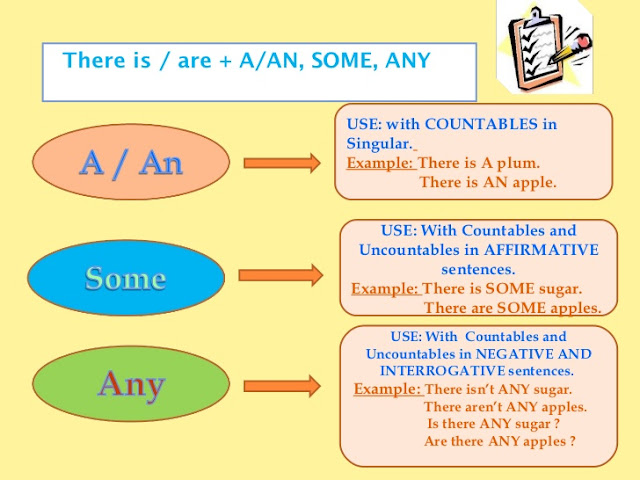
THERE IS/ THERE ARE

THERE IS / THERE ARE

1. COMPLETE THE SENTENCES

1. There _____ thirty students in my class.
2. There _____ some books in my bag.
3. There _____ some computers in the library.
4. There _____ a blackboard in the classroom.
5. There _____ a CD player on our teacher´s desk.
6. There _____ some posters.
7. There _____ some dictionaries in the classroom.


2. COMPLETE THESE SENTENCES. USE THE NEGATIVE

1. ___________ any shopping centres in this town.
2. ___________any beaches in London.
3. ___________an American café here.
4. ___________a Hollywood in Spain.
5. ___________any rap CDs in this shop.

3. WRITE QUESTIONS AND SHORT ANSWERS

Example:
/ any Brazilian footballers in your favourite team?
Are there any Brazilian footballers in your favourite team? Yes there are.
1. / a skateboard park near here?
_____________________________
No, __________________________
2. / a Hollywood in Ireland?
_____________________________
Yes, __________________________
3. / any famous football teams in your town?
_____________________________
Yes, __________________________
4. / any interesting places near your house?
_____________________________
No, __________________________
5. / an English boy in your class?
_____________________________
No, __________________________

NOW, YOU CAN CHECK YOUR ANSWER. 


ANSWERS

1. 
1. There are thirty students in my class.
2. There are some books in my bag.
3. There are some computers in the library.
4. There is a blackboard in the classroom.
5. There is a CD player on our teacher´s desk.
6. There are some posters.
7. There are some dictionaries in the classroom.

2. 
1. There aren´t any shopping centres in this town.
2. There aren´t any beaches in London.
3. There´s isn´t an American café here.
4. There´s isn´t a Hollywood in Spain.
5. There aren´t any rap CDs in this shop.

3. 
1. Is there a skateboard park near here? No, there isn´t.
2. Is there a Hollywood in Ireland?
Yes, there is.
3. Are there any famous football teams in your town?
Yes, there are.
4. Are there any interesting places near your house?
No, there aren´t.
5. Is there an English boy in your class?
No, there isn´t

WHICH FOOD AM I?


GUESS...


PARTITIVES


NOW, PRACTICE NEW VOCABULARY ABOUT PARTITIVES

http://a4esl.org/q/h/9801/cr-noncountfood.html

https://agendaweb.org/grammar/containers-partitives-exercises.html

FOOD PARTITIVES - a box of, a bunch of ...

domingo, 2 de diciembre de 2018

DICTATION

DICTATION ABOUT FOOD.

1. They're orange, yellow and green.They've got a lot of vitamin C.
2. It's a dark brown drink made from a type of bean. A lot of people drink it in the morning.
3. It comes from bees.It's very sweet. You can eat it on bread.
4. They can be green or black. They taste salty. They don't grow in Jamaica.
5. They come from tall trees. They 're brown and hard. They've got liquid inside.
6. They can be green, red or white. We use them in lots of recipes. They're very healthy.
7. It's very sweet. A lot of people put it in coffee. You use ir when you make a cake.
8. They help foods taste more interesting. They can be a lot of different colours and tastes.
9. It's a type of cereal. It's a very important ingredient in Chinese and Indian food and in paella.
10. it's white and a little bit of it  makes food taste better. You put it on the table.

IF YOU MAKE MORE THAN 7 MISTAKES YOU HAVE TO COPY IT AGAIN WITHOUT ANY MISTAKES. PAY ATTENTION AND TRY TO UNDERSTAND THE TEXT.

jueves, 15 de noviembre de 2018

ADJECTIVES AND THE GRADES

Fill in the correct form of the words in brackets (comparative or superlative).
  1. My house is (big)  than yours.
  2. This flower is (beautiful)  than that one.
  3. This is the (interesting)  book I have ever read.
  4. Non-smokers usually live (long)  than smokers.
  5. Which is the (dangerous)  animal in the world?
  6. A holiday by the sea is (good)  than a holiday in the mountains.
  7. It is strange but often a coke is (expensive)  than a beer.
  8. Who is the (rich)  woman on earth?
  9. The weather this summer is even (bad)  than last summer.
  10. He was the (clever)  thief of all.

Comparative and Superlative Adjectives

Here are examples of comparative and superlative adjectives that kids might enjoy and find familiar.
The adjective is listed first, followed by the comparative adjective and then the superlative adjective:
  • Angry - angrier - angriest
  • Anxious - more anxious - most anxious
  • Big - bigger - biggest
  • Brave - braver - bravest
  • Bright - brighter - brightest
  • Broad - broader - broadest
  • Calm - calmer - calmest
  • Cold - colder - coldest
  • Cool - cooler - coolest
  • Curly - curlier - curliest
  • Dark - darker - darkest
  • Dirty - dirtier - dirtiest
  • Dull - duller - dullest
  • Dry - drier - driest
  • Early - earlier - earliest
  • Easy - easier - easiest
  • Embarrassed - more embarrassed - most embarrassed
  • Evil - more evil - most evil
  • Famous - more famous - most famous
  • Fine - finer - finest
  • Fresh - fresher - freshest
  • Hard - harder - hardest
  • Heavy - heavier - heaviest
  • Long - longer - longest
  • Lovely - lovelier - loveliest
  • Nervous - more nervous - most nervous
  • New - newer - newest
  • Old - older - oldest
  • Perfect - more perfect - most perfect
  • Quick - quicker - quickest
  • Rich - richer - richest
  • Sad - sadder - saddest
  • Simple - simpler - simplest
  • Small - smaller - smallest
  • Smart - smarter - smartest
  • Soft - softer - softest
  • Sweet - sweeter - sweetest
  • Thin - thinner - thinnest

Adjectives with Irregular Forms

Some adjectives have irregular forms when made into comparative or superlative adjectives. They do not ads an "er" or "est" and they don't add the words more or most. In fact, in some cases, a whole new word is used.
Here are some examples with the adjective first, then the comparative adjective and then the superlative adjective:
  • Bad - worse - worst
  • Good - better - best
  • Far - farther - farthest
  • Little - less - least
  • Much - more - most
  • Many - more - most

Sentences with Comparitive Adjectives

  • My house is bigger than yours.
  • Your grade is worse than mine.
  • The Pacific Ocean is deeper than the Arctic Ocean.
  • You are more polite than Joey.
  • My brother is taller than me, but he is younger, too.
  • A rose is more beautiful than a daisy.
  • The Earth is larger in diameter than the moon.
  • A pint is less than a quart.

Sentences with Superlative Adjectives

  • I can't find my most comfortable jeans.
  • The runt of the litter is the smallest.
  • Jupiter is the biggest planet in our Solar System.
  • She is the smartest girl in our class.
  • This is the most interesting book I have ever read.
  • I am the shortest person in my family.
  • Jerry is the least worried about the game.
  • That was the best movie ever.
  • Sam is the most handsome boy in the whole school.
  • Mount Everest is the highest mountain in the world.


martes, 23 de octubre de 2018

READERS


Here you have the list of the titles about English books that you have to read. You should read two titles...Choose the ones you like best


Os estructuramos los títulos por niveles de manera que cada uno podrá elegir aquel que crea más conveniente a su nivel. Probablemente os daréis cuenta que sois capaces de entender más de lo que pensáis así que os animamos a que leáis tranquilos y que lo peor que os pueda pasar es que tengáis que echar mano del diccionario más veces de las que os gustaría pero eso será solo al principio. Todo trabajo tiene su esfuerzo pero todo esfuerzo tendrá su recompensa.

In our library you can find some titles so, before buying them, check it!

LOW LEVEL


KIDNAP- ED. OXFORD
THE GIRL WITH RED HAIR- ED. OXFORD
FOOD FOR THE WINTER- ED. HEBLING YOUNG READERS
BEAUTY AND THE BEAST- ED. HEBLING YOUNG READERS


MEDIUM LEVEL

DR. DOLITTLE- ED. BURLINGTON
THE ADVENTURE OF TOM SAWYER- ED. OXFORD
HAWK-EYE, THE PATHFINDER-  ED. MACMILLAN

HIGH LEVEL

THE GHOST TEACHER- ED. BURLINGTON
CLIMATE CHANGE- ED. OXFORD
THE CURSE OF THE MUMMY- ED. OXFORD